Beefed Up Fencing at San Diego Border

A Mexican couple hugs in front of the Mexican side of the fourteen-mile-long argue that separates Tijuana from San Diego, visible in the groundwork. Omar Torres/AFP/Getty Images hide caption
toggle caption
Omar Torres/AFP/Getty Images

A Mexican couple hugs in front of the Mexican side of the xiv-mile-long fence that separates Tijuana from San Diego, visible in the groundwork.
Omar Torres/AFP/Getty Images

"Coffins" with the word "deaths" written on them in Spanish hang along the Mexican side of the edge fence. Activists say the wall has forced immigrants to accept life-risking routes through the desert to cross into the United states. Ted Robbins, NPR hide explanation
toggle caption
Ted Robbins, NPR

The crew of an independent film dealing with immigration shoots a scene by the contend that divides Tijuana from Imperial Beach, southward of San Diego. In Mexico, the fence has become a cultural icon of sorts. Ted Robbins, NPR hide explanation
toggle caption
Ted Robbins, NPR
The U.South. House has voted to create a barrier argue along 700 miles of the U.Southward. border with Mexico. Supporters say the fencing will bolster national security and curb illegal clearing. Opponents decry it as a new "Berlin Wall." NPR's Ted Robbins helps explain the proposal and existing border barriers.

An overhead view of the double- and triple-fencing used in the xiv-mile-long border contend separating San Diego and Tijuana. In the enlarged image, a Tijuana neighborhood is visible at left. The open field at correct is in California. Ted Robbins, NPR hide caption
toggle caption
Ted Robbins, NPR
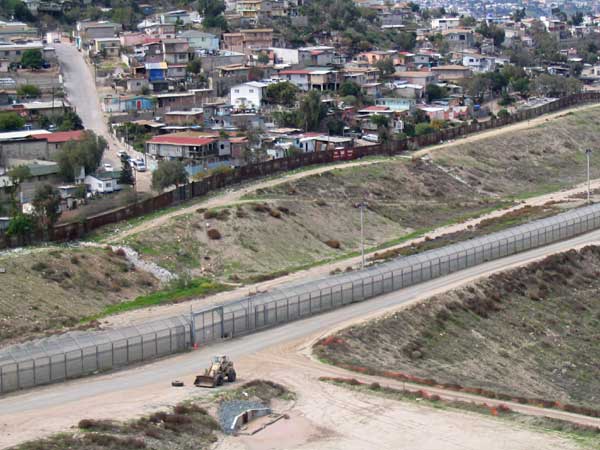
An overhead view of the double- and triple-fencing used in the xiv-mile-long edge fence separating San Diego and Tijuana. In the enlarged epitome, a Tijuana neighborhood is visible at left. The open field at right is in California.
Ted Robbins, NPR
As Congress looks to revamp immigration policy, some lawmakers are pushing to extend fencing forth the U.S. border with Mexico. Proposals range from beefing upwardly existing fences in Arizona to amalgam new fences that would span 700 miles. Those advocating expanded fencing already have a model they can look to: a fence the federal government built more than a decade ago along a xiv-mile-stretch in San Diego, Calif., that borders Tijuana, United mexican states.
To those on the U.Southward. side, the fences in urban areas between Mexico and the United States are a symbol of security. Very few sections are painted or adorned in any way.
To many Mexicans, though, the fence is either an insult to exist covered up, or a business opportunity. In Nogales, Sonora, shopkeepers say they are offended that the The states built a wall betwixt them and their twin city, Nogales, Ariz. In Tijuana, long stretches of the fence are covered in advertisements or posters. Another section has crosses and coffins nailed to information technology, in memory of those who died trying to immigrate.
And at Purple Beach, which is separate at the border by giant steel pillars sunk into the sand, a movie crew shoots what is billed as a "Castilian-language, science-fiction love story" with the fence as a properties... immigration politics as entertainment.
Earlier the fence was built, all that separated that stretch of Mexico from California was a single strand of cable that demarcated the international edge.
Back then, Border Patrol amanuensis Jim Henry says he was overwhelmed by the stream of immigrants who crossed into the Us illegally just in that sector.
"Information technology was an expanse that was out of control," Henry says. "There were over 100,000 aliens crossing through this area a year."
Today, Henry is assistant primary of the Edge Patrol'southward San Diego sector. He says apprehensions here are down 95 percent, from 100,000 a twelvemonth to 5,000 a yr, largely because the single strand of cable mark the border was replaced by double -- and in some places, triple -- fencing.
The starting time fence, 10 feet loftier, is fabricated of welded metal panels. The second debate, 15 feet high, consists of steel mesh, and the top is angled inward to get in harder to climb over. Finally, in high-traffic areas, at that place's also a smaller concatenation-link fence. In between the ii main fences is 150 anxiety of "no man's land," an area that the Edge Patrol sweeps with flood lights and trucks, and soon, surveillance cameras.
"Here in San Diego, nosotros accept proven that the edge infrastructure system does indeed work," Henry says. "It is highly constructive."
Rancher Carol Kimsey, who lives in a valley well-nigh the Pacific Sea on the U.Southward.-side of the fence, says the border barrier has improved the quality of life in the area.
"Information technology was pretty seriously bad," she recalls of the prefence days. "They were tearing up everything. They'd just get through fences. They didn't intendance."
Kimsey says life is more peaceful now, despite the Border Patrol helicopters circumvoluted nearby. This is still an active smuggling route, particularly for drugs. A stretch of edge where there's only one debate is referred to as Smugglers' Gulch. The Border Patrol is moving frontwards with plans to add a second fence at that place as well as forth the final 3.5 miles to the ocean, which had been held up by years of litigation over environmental concerns.
The actress fencing volition cost at least $35 million. But Claudio Smith, an attorney and edge activist, says the cost has been much higher in man lives. She says the fencing has simply forced immigrants to take more than dangerous routes through the mountains and scorching-hot deserts.
"It didn't cease people from crossing," she says. "It just forced them to cross in the deadliest stretches of the border."
An estimated 3,600 people have died crossing the U.S. border since the fences went up.
Information technology is now harder to cross the border into the Us, and too more than expensive. Border crossers say they pay human smugglers, or coyotes, much more than they did a decade ago.
Smith says the debate has actually created a sort of perverse and unintended consequence: It is keeping people in the U.s.a. who used to go back to Mexico.
"The men would come up for a number of months out of every year and return (to United mexican states)," Smith says. "Now, not only are the men staying, but they're bringing their families."
During the last decade, millions of people accept connected to cantankerous the edge illegally -- mostly in Arizona. That'southward the adjacent target for those who want to build double- and triple-fencing.
Source: https://www.npr.org/templates/story/story.php?storyId=5323928
0 Response to "Beefed Up Fencing at San Diego Border"
Post a Comment