Did Trump Cut Funding for People Who Review Asylum Cases
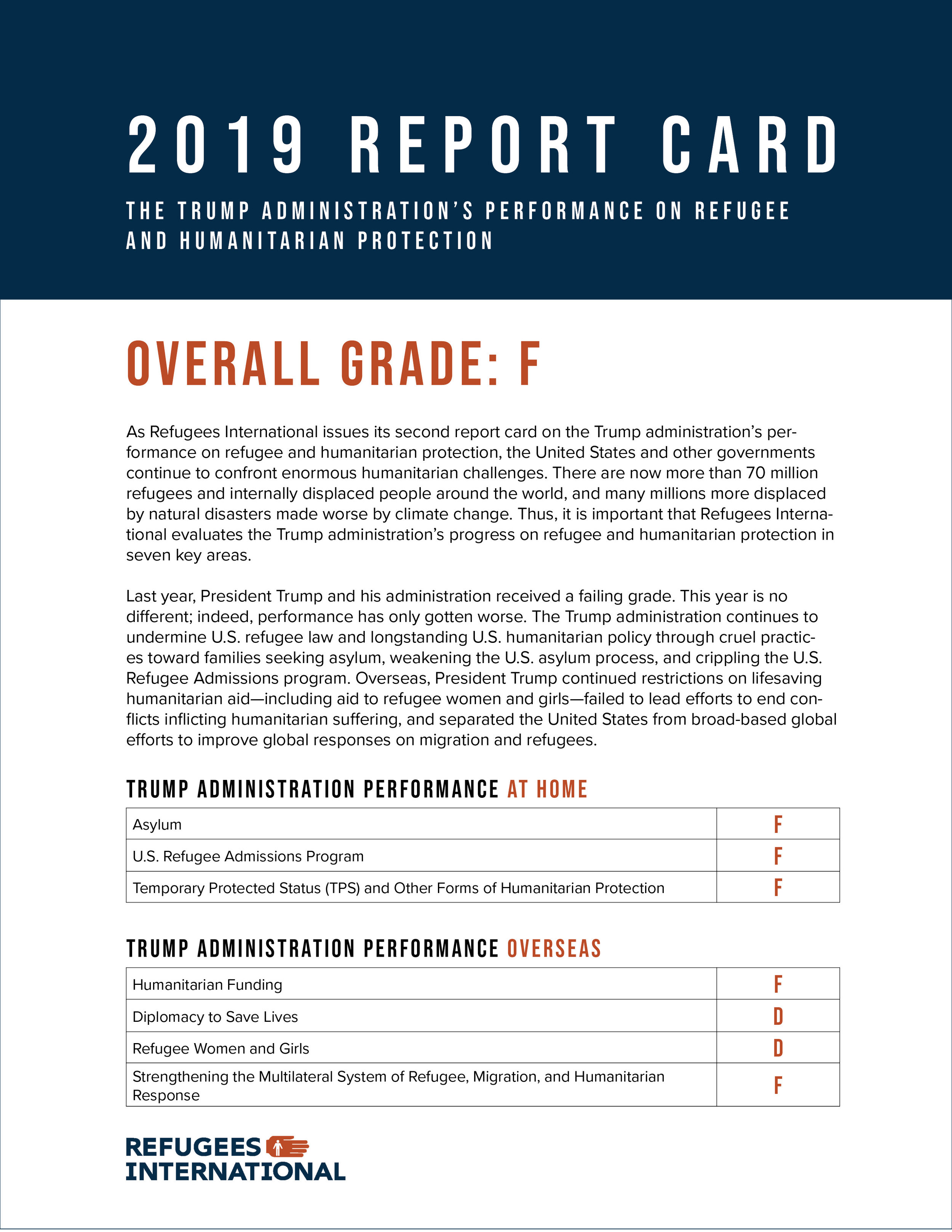
As Refugees International issues its 2d report carte on the Trump administration'southward performance on refugee and humanitarian protection, the United states of america and other governments continue to confront enormous humanitarian challenges. There are now more than than 70 1000000 refugees and internally displaced people around the world, and many millions more displaced by natural disasters made worse past climate change. Thus, it is important that Refugees International evaluates the Trump administration's progress on refugee and humanitarian protection in vii key areas.
Last yr, President Trump and his administration received a failing grade. This twelvemonth is no different; indeed, functioning has merely gotten worse. The Trump assistants continues to undermine U.South. refugee police and longstanding U.S. humanitarian policy through cruel practices toward families seeking asylum, weakening the U.S. asylum procedure, and crippling the U.South. Refugee Admissions program. Overseas, President Trump continued restrictions on lifesaving humanitarian aid—including help to refugee women and girls—failed to pb efforts to stop conflicts inflicting humanitarian suffering, and separated the The states from broad-based global efforts to improve global responses on migration and refugees.
Overall Form F
Introduction
In our 2018 Report Card, Refugees International noted that governments effectually the world confronted humanitarian challenges of enormous proportion. Sadly, those challenges have increased since then. At that place are now more than 70 million refugees and internally displaced people (IDPs) around the world. Considering the United States has long played a critical function in helping to meet the needs of refugees and IDPs, it is appropriate and important that Refugees International evaluates the Trump administration'due south progress on refugee and humanitarian protection.
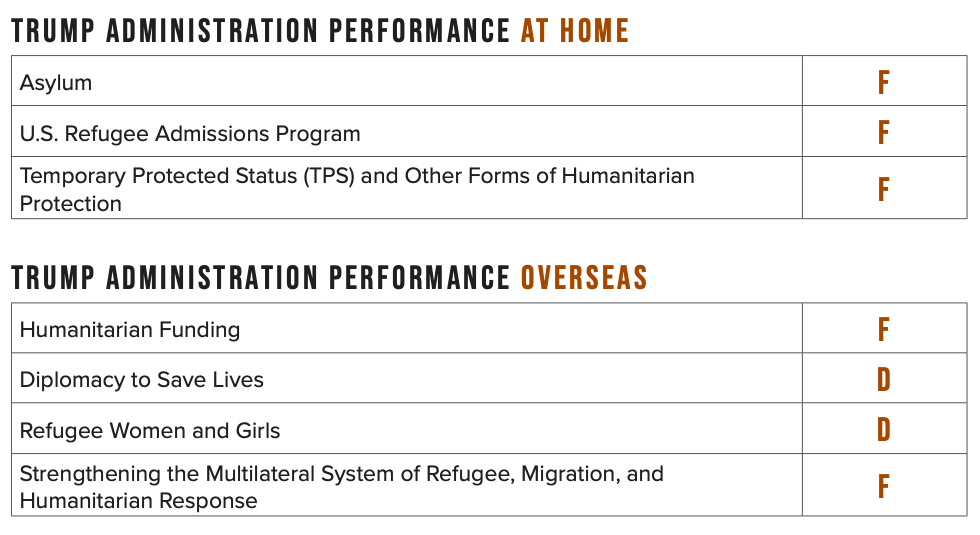
We have evaluated the Trump administration in vii critical areas both in the United States and overseas. Equally was the instance terminal year, the Trump administration has received an overall failing form for its policies and operation. Nonetheless, equally the assay in this written report carte du jour demonstrates, the poor operation of the Trump administration has further deteriorated over the past yr. In short, policies that already merited a failing course have gotten worse.
Over the past 12 months, the Trump assistants has connected and accelerated measures to eliminate protections for refugees and aviary seekers nether U.S. law, likewise every bit weaken the international arrangement of humanitarian and refugee response. These have included:
-
Systematic efforts to effectively end asylum for large numbers of credible claimants at the U.S. southern border.
-
Connected and stepped up attempt to cripple the U.S. Refugee Admissions Program.
-
Rejection of international compacts on enhanced protection and direction of migrants and refugees endorsed by an overwhelming majority of other governments.
-
Proposals for massive cuts to U.Southward. international humanitarian assistance.
-
The absenteeism of presidential leadership on efforts to respond to or fifty-fifty recognize massive human rights violations and forced migrations in places similar Myanmar.
The deportment of the Trump administration have been discouraging. But as we wrote in terminal year'due south report, in that location is trivial that prevents President Trump and his administration from changing course and substantially improving U.S. practices to bring them into conformity with both international refugee law and all-time practices.
Grading Criteria
For many decades, the U.s.a. has led the international community in supporting refugees and displaced people and in upholding international humanitarian principles. This is reflected in dozens of laws, expressions of policy, generous funding, and statements by U.S. officials. In assessing the functioning of the Trump administration, Refugees International sets out three broad categories for review:
-
U.Southward. Commitment to International Humanitarian Leadership: Examples of this delivery over many decades are varied. It appears in the Refugee Act of 1980, the bipartisan legislation overwhelmingly enacted by both houses of Congress, in which the U.S. government alleged that it is the "historic policy of the United States to respond to the urgent needs of persons subject to persecution in their homelands." A potent and bipartisan willingness by the U.Southward. Congress to generously fund refugee and humanitarian assistance too reflects the U.S. delivery. Finally, President Trump has articulated the importance of international humanitarian leadership himself. At the United Nations General Associates in 2017, for case, the president declared that "the United States continues to atomic number 82 the earth in humanitarian aid," noting efforts in Southward Sudan, Somalia, northern Nigeria, and Yemen, every bit well as on a range of health, gender, and human rights-related initiatives.
-
U.S. Commitments to Protecting Refugees: These are nigh clearly reflected in U.South. accretion, during the Lyndon Johnson administration, to the 1951 Convention Relating to the Status of Refugees and its 1967 Protocol, which include the prohibition against returning any individual to a country where his or her "life or liberty would be threatened on account of his [or her] race, religion, nationality, or membership of a particular social group or political opinion." U.S. commitments are also reflected in the Refugee Human activity of 1980, which established an annual process for refugee admissions to the United States. In that location is also U.Due south. asylum law, by which individuals already in the United States or seeking entry at U.S. borders are considered for asylum based on a fear of persecution in their home countries.
-
U.Due south. Commitments to Lifesaving Humanitarian Assistance Based on Need: In 1984, in justifying its decision to provide humanitarian assistance to famine-afflicted Federal democratic republic of ethiopia, the Reagan administration declared that "a hungry child knows no politics." Indeed, U.South. officials accept long endorsed a commitment to ensure that lifesaving and life-sustaining humanitarian assistance should be based on humanitarian need, consistent with the principle of humanity (i.e., the belief that profound humanitarian suffering must exist addressed wherever it is found).
Trump Administration Functioning at Abode
Asylum
Grade: F (Unsatisfactory—failing grade)
Nether U.Southward. law and the 1951 Convention Relating to the Condition of Refugees and its 1967 Protocol, asylum provides protection for individuals fleeing their countries of origin due to persecution based on race, organized religion, nationality, political opinion, or membership in a social group. It is a critically important safeguard confronting render to persecution. Individuals already present in the United States may request asylum, and asylum may likewise be requested at ports of entry.
The Trump administration has undermined protection for aviary seekers over the by year in three overarching and dramatic ways. The president and others in his administration take also inappropriately bandage aspersion on asylum seekers and the aviary system to promote more restrictive policies.
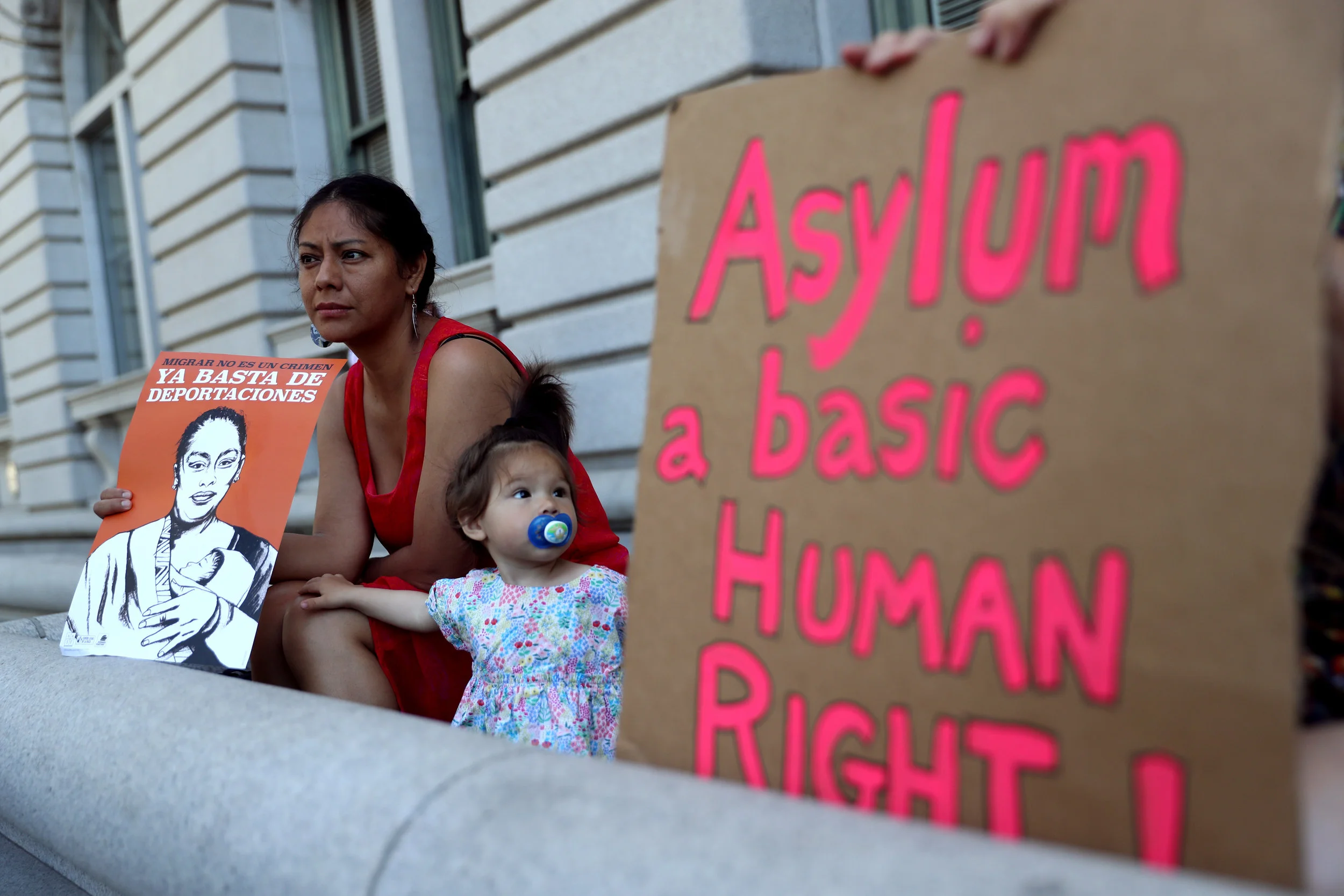
A protester holds a sign during a demonstration exterior of the James R. Browning U.S. Courthouse in support of restoring protections for aviary seekers. Photo Credit: Justin Sullivan/Getty Images.
First, the Trump assistants has implemented policies that inhibit asylum seekers from accessing U.S. territory and exercising their right to enquire for asylum. Since tardily January 2019, through the "Remain in Mexico" policy, U.S. officials take summarily interviewed tens of thousands of aviary seekers who have sought refuge at the U.S. southern border and so promptly returned them to Mexico to wait adjudication of their cases by U.S. immigration judges. The administration has failed to put in place acceptable safeguards to ensure that those returned to Mexico will not be subject to violence and persecution. Moreover, while waiting in Mexico for court dates in the Us, aviary seekers often lack access to food and shelter and take dandy difficulty finding attorneys, whose engagement can be critical to gaining asylum. The Department of Homeland Security has separated families, sending some members to Mexico and keeping others in the United states of america.
The "Remain in United mexican states" policy supplements another Trump administration practice called "metering," which forces asylum seekers to expect in Mexico for weeks or even months before they can even register their aviary claims. These asylum seekers—women, men, and children—are beingness turned away by border officials without whatsoever protection and forced to look in Mexican border cities until they are called from informal waitlists. Later being chosen and registering their claims, they will often wait additional weeks and months in United mexican states during the arbitrament process.

A man holds a babe upwards to the edge wall betwixt United mexican states and U.s.. Photo Credit: HERIKA MARTINEZ/AFP/Getty Images.
In August 2019, the Trump administration began to ban aviary for anyone who transited through a third country that is party to the Refugee Convention, the 1967 Refugee Protocol, or the Convention against Torture. This policy is being challenged in court on the ground that it violates U.South. police, which only limits aviary seeking by those "firmly resettled" in a transit country. Finally, the Trump assistants has recently negotiated a so-called "Safe Third Country" agreement that, if implemented, would enable the administration to send asylum seekers to Guatemala, a country that is non safe and lacks chapters to process asylum claim as required under U.S. law. In improver, the president has asked the attorney general to issue regulations that would add together fees to aviary applications and preclude asylum seekers from working legally during their asylum proceedings.
The administration has justified these policies as ways to screen out claims that are unlikely to succeed and to deter those without a genuine need for aviary from making the arduous and unsafe journey from Central America to the The states. But the policies discriminate against asylum seekers from particular countries. In addition, and nigh crucially, they block aviary seekers regardless of the claim of their claims and put them at risk of persecution or other abuses by traffickers or drug cartels. This is a clear violation of international treaty obligations and U.S. asylum law. It is also unsurprising since President Trump has called asylum law "ridiculous" and labeled all asylum seeking "a scam."
Second, the Trump administration has fabricated it much more difficult for those who manage to inquire for asylum to take information technology granted. The assistants has unreasonably toughened the standards used by asylum officers considering the threshold "apparent fear" determination. For case, prior guidance to officers on considering trauma and cultural background when determining credibility has been withdrawn. The assistants has likewise given border patrol officers, whose priority is enforcement and not consideration of aviary claims, the authority to handle these determinations. The assistants has insisted that immigration judges fast-track asylum cases and has recently appointed to the Board of Clearing Appeals (BIA), which hears appeals in asylum cases, among others, immigration judges who have denied aviary cases at much college rates than clearing judges nationally. The attorney general has too issued decisions that overturn BIA rulings granting aviary to those who seek refuge from gender-based violence and because of damage targeting them as members of detail families. These decisions put asylum seekers at grave risk.
Third, the Trump assistants has connected to detain asylum seekers inhumanely and unnecessarily. In an April 2019 decision, the attorney general ruled that even asylum seekers who had established a credible fright of persecution were ineligible for a bond hearing past an immigration judge. In August 2019, the administration published a rule that would expand and prolong family detention and revoke standards protecting children in custody. Using immigration detention as a penalisation is illegal, and holding children earnest to deter asylum seekers—as appears to be the case—is unconscionable. Detaining asylum seekers is all-the-more troubling in lite of effective alternatives to detention. Moreover, as several of DHS's own reports have shown this year, conditions in detention are appalling. Detaining asylum seekers this way dehumanizes them, as does the president's references to asylum seekers every bit "invaders" and his jokes virtually violence against them. Incendiary comments such every bit these have led to hostility toward those seeking protection in the United States.
The U.S. Refugee Admissions Program
Course: F (Unsatisfactory—failing grade)
Since passage of the Refugee Act of 1980 (unanimously in the Senate and by a huge bipartisan majority in the Firm), the United States has successfully resettled more than 3 one thousand thousand refugees under the U.S. Refugee Admissions Program. Under this program, the president, afterward consulting Congress, annually determines how many refugees the United States will resettle from countries of temporary refuge effectually the world. Other countries besides resettle refugees every bit office of an international effort to share responsibleness.
While refugee resettlement is a solution for simply a small percentage of the earth's refugees, information technology can exist a critically important solution for especially vulnerable refugees as well as refugees in other special circumstances (such as those who accept been in protracted situations). Moreover, a U.S. commitment to refugee resettlement signals a willingness to share responsibilities with governments—such every bit Turkey, Hashemite kingdom of jordan, Uganda, Ethiopia, and many others—hosting many hundreds of thousands and even millions of refugees.
Since taking office, nonetheless, the Trump administration has reduced refugee admissions dramatically, to the everyman levels since the outset of the U.Southward. Refugee Admissions Programme in 1980. It has washed this despite the well-documented social and economic benefits of the resettlement of refugees for the United States and despite the fact that purported threats posed past refugees have been wildly exaggerated. In FY2018, the Trump administration came nowhere near reaching the then tape-low ceiling of 45,000 it had announced, albeit only 22,491 refugees (too an historic low). For FY2019, the Trump administration announced a ceiling of 30,000 refugee admissions, some other celebrated depression.
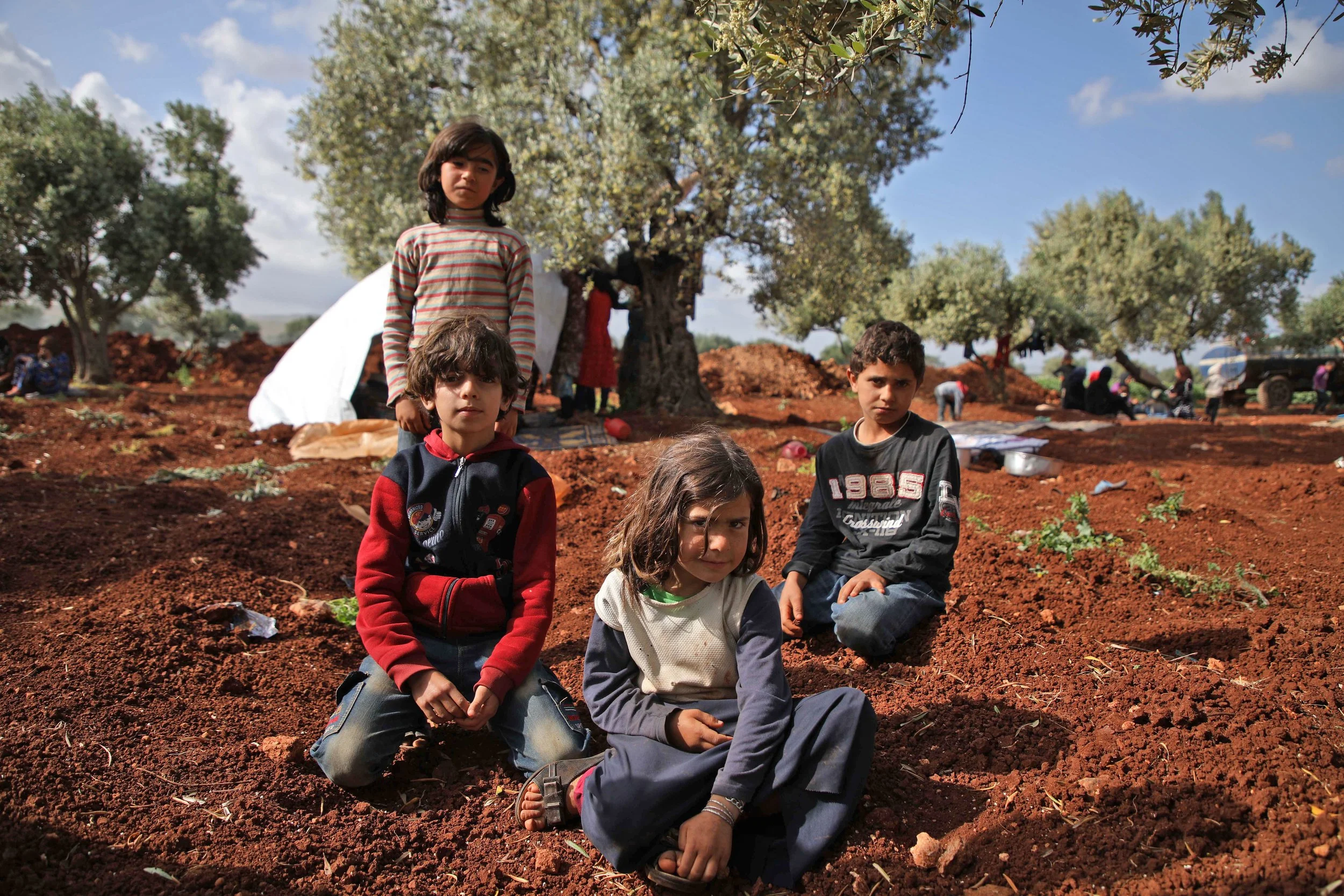
Displaced Syrian children living in an olive grove in Atme, Syria. Photo Credit: AAREF WATAD/AFP/Getty Images.
The Trump administration has also dramatically reduced the percentage of resettled refugees from Muslim-majority countries, despite the fact that such refugees make up a substantial proportion of refugees worldwide. In 2016, the terminal year of the Obama administration, some 47 percent of refugees resettled in the United States were from Muslim-majority countries. In the outset nine months of FY2019, that percentage was only 11 percent. Betwixt October 2018 and July 2019, fewer than 650 refugees arrived in the United States from Syria, Somalia, and Yemen combined—countries all suffering from war and humanitarian crisis. The assistants has as well slowed to a trickle the admission of Iraqis, many of whom assisted U.Due south. forces, and recently closed U.South. Citizenship and Clearing Services international offices that process applications allowing refugees to join family unit members in the United states of america.
The Usa has abandoned its leadership on resettlementat a time when the number of refugees is at the highest level in recorded history. The administration's FY2020 budget request also drastically cuts funding for services for refugees. In recent weeks, some administration officials have reportedly suggested settling no refugees at all in the United states of america in 2020. The administration is also reportedly preparing a new policy that would allow state and local jurisdictions to deny entry to refugees who have been approved for resettlement in the United states. This measure is not merely unnecessary and probably illegal (every bit the Refugee Human activity already has a provision relating to consultation with states and localities on distribution of refugees), only it volition too strand refugees oversees, hurt American communities revitalized by resettlement, and dangerously undermine maintenance of unified national immigration policies.
Temporary Protected Status (TPS) and Other Forms of Humanitarian Protections
Grade: F (Unsatisfactory—failing course)
Under U.Southward. law, Temporary Protected Condition (TPS) provides humanitarian protection in the United States to foreign nationals from designated countries who are unable to return home due to conflict, natural disasters, or other boggling weather. The Trump assistants's efforts to revoke TPS for approximately 320,000 individuals from some of the about crunch-affected countries in the world—including El salvador, Haiti, and Sudan—many of whose children have American citizenship, accept been halted, at least for time being, past the federal courts. Though the administration has recently extended TPS for Syrian arab republic, it has non re-designated Syria for TPS, thus failing to protect Syrians recently arrived in the Us. Legislation providing TPS status for Venezuelans passed the House with bipartisan support, but the Senate has not acted and the administration has refused to designate Venezuela despite engagement with the Venezuelan crisis and professed concern nigh displaced Venezuelans.
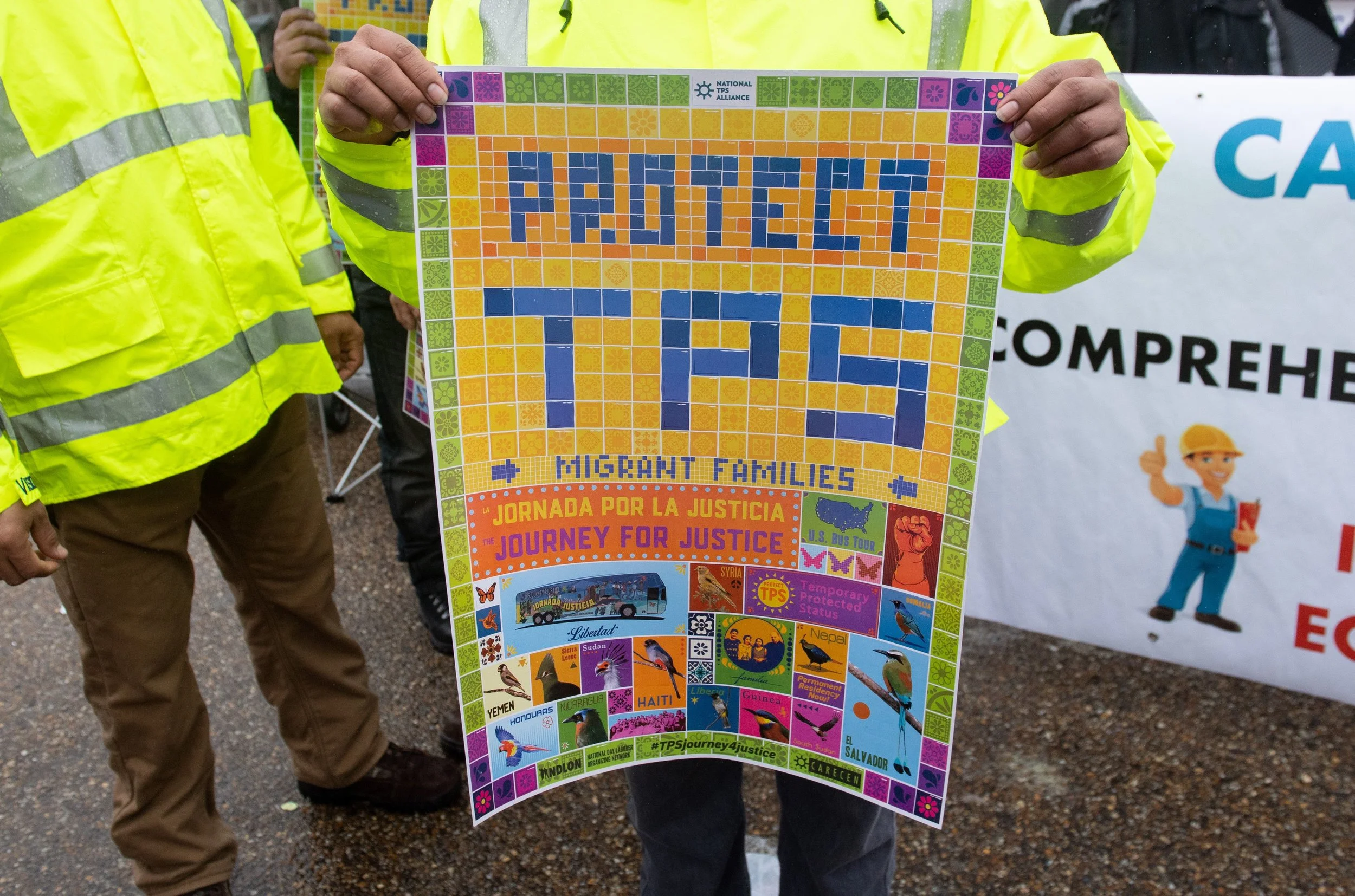
Demonstrators participate in the March for Temporary Protected Status (TPS) Justice at a protest exterior the White House. Photograph Credit: SAUL LOEB/AFP/Getty Images.
Trump Assistants Operation Overseas
Humanitarian Funding
Form: F (Unsatisfactory—failing grade)
Equally has been the instance in each of the years of this administration, President Trump's budget proposal for 2020 has included dramatic cuts to lifesaving U.S. assistance to those around the world experiencing humanitarian crises, despite the fact that such funding constituting far less than 1 percent of the federal upkeep. The Trump administration has likewise unreasonably denied critical aid to vulnerable communities around the world.
Seeking to cut foreign aid: Unveiled in early 2019, the Trump administration's 2020 budget proposal called once again for unprecedented cuts—about 30 percentage—that would dramatically reduce U.S. food assistance, "aught out" a critical refugee emergency fund, and significantly reduce contributions to maternal and kid health, and peacekeeping activities, among other reductions. The U.S. Congress has soundly rejected these kinds of proposed cuts in prior years, and Refugees International hopes and expects that this will exist the instance once again. In 2018 and 2019, the Trump administration attempted to brand rescissions—the cancellation of monies provided past Congress—of billions of dollars in foreign assistance. While these rescissions did non straight target humanitarian aid, such cuts to development support and other programming would have devastated the overall capacity of operational organizations in the field. Thankfully, Congress and the NGO community forcefully and successfully pushed back but this was yet another demonstration of the administration'southward perspectives on foreign help.
Denying critical assistance to vulnerable communities:Having been denied its preferred funding reductions by Congress in the legislative process, the Trump administration has at times proposed and implemented devastating funding freezes to fundamental strange help programs and used questionable tactics to circumvent legislative authority. Reprogramming of Land Section and USAID funding has been used every bit a tool by the president to punish countries, nigh notably in the case of targeting FY2017, FY2018, and FY2019 foreign assist funds for Primal America. These measures, which undermine both fundamental humanitarian (and strategic) objectives, were strongly opposed past key members of both parties on Capitol Colina. And though the funds targeted came from development rather than humanitarian funding accounts, the humanitarian implications for Central Americans were obvious.
Diplomacy to Save Lives
Grade: D (Unsatisfactory, though minimally acceptable)
Failure of presidential leadership in humanitarian crisis prevention and response:As was the instance final year when we reported on this issue, among the humanitarian crises currently causing the greatest suffering are those in Myanmar, Syria, and Republic of yemen. President Trump is responsible for none of them, but U.S. presidential leadership could be critical to mitigating hereafter suffering. To date, the president's deportment—and failures to deed—accept been extremely damaging to vulnerable populationsin these countries.

Law officer in Rakhine state, Myanmar. Photograph Credit: Min Kyi Thein/AP Photograph.
Myanmar: The brutal expulsion of some 700,000 Rohingya in 2017, and the killings of many thousands more than by Myanmar's security forces, were incidents of indigenous cleansing, crimes confronting humanity, and abuses among the most egregious in modern history. Senior American officials, including Vice President Mike Pence and Secretary of State Mike Pompeo and his predecessor, Male monarch Tillerson, have publicly decried these atrocities, with the vice president invoking President Trump's proper name in a call for Un Security Council action. In November of 2018, the vice president told Myanmar's de facto leader, Aung San Suu Kyi, that "the violence and persecution by armed forces and vigilantes that resulted in driving 700,000 Rohingya to People's republic of bangladesh is without alibi." He further asked her about progress toward accountability for those who perpetrated such crimes. In addition, some Myanmar security officials accept been subjected to targeted sanctions, including a visa ban against Commander-in-Chief of the Myanmar Military machine Senior General Min Aung Hlaing.
Just these actions have been deadening, do not become near far enough, and exercise not represent a serious or comprehensive strategy designed to promote accountability and render of Rohingya refugees in safety and dignity from Bangladesh to Myanmar, with respect for their homo rights.
Most significantly, President Trump himself has been silent on the horrendous atrocities committed by the authorities of Myanmar. The absence of presidential leadership undermines whatsoever international effort to convince Myanmar to create conditions that may ultimately permit the Rohingyas' return in prophylactic and dignity. And when a Rohingya ceremonious society leader visited the White Business firm as function of the U.Southward.-hosted Ministerial to Accelerate Religious Freedom and asked what the Usa might practise to help the Rohingya, the president's response was to ask, "Where is that exactly?"
Moreover, and despite a careful Land Department review of abuses committed by the Myanmar military, it is inexplicable that the Department has failed to country the obvious conclusion that the armed services are responsible for crimes confronting humanity. Nor has the State Department offered any views on the appropriateness of a formal investigation of whether the crime of genocide has been committed. This silence is further evidence of the U.Due south. lack of global leadershipon this event.
Syria: While the Trump administration has slowed its disengagement from northeast Syria, its policy arroyo continues to lack coherence—in large mensurate due to disharmonize between apparent disinterest from President Trump and concerns among senior officials that the Us should not hastily disengage. The resulting uncertainty led other major donors to temporarily suspend a much-needed recovery assistance for the civilian population in places like Raqqa, the erstwhile upper-case letter of the Islamic Land. The administration has been partially successful in negotiating with Turkey a express buffer zone between Turkey and Syrian-Kurdish forces in northeast Syria. However, it has failed to commit adequate diplomatic resource toward efforts to address the humanitarian catastrophe in Idlib in Syrian arab republic'south northwest. This has given Russian federation and the Syrian regime a free manus in the region. In belatedly Apr 2019, they launched a brutal military campaign that has killed hundreds of civilians and displaced more than than half a million people. Many more remain under threat in Idlib, where two-thirds of the about three million civilians depend on humanitarian assist.
Yemen: In Yemen, at that place are more 24 one thousand thousand people in need of aid and protection, according to the UN Office for the Coordination of Humanitarian Diplomacy. The Trump assistants has consistently failed to bring pressure to deport on the Saudi-led coalition to end abuses against civilians harmed past war machine operations. President Trump vetoed iii joint congressional resolutions prohibiting his administration from selling weapons worth billions to Kingdom of saudi arabia and the United Arab Emirates. The president did this despite reports that the Saudi-led coalition has engaged in indiscriminate bombing and killed thousands of Yemeni civilians. The continued administration support to Saudi Arabia will likely exacerbate the dire humanitarian situation in the country where some twenty million Yemenis are food insecure and about ten million of them are "one footstep away from dearth." Moreover, by late 2018, more than than 85,000 Yemeni children under five are estimated to have died from starvation.
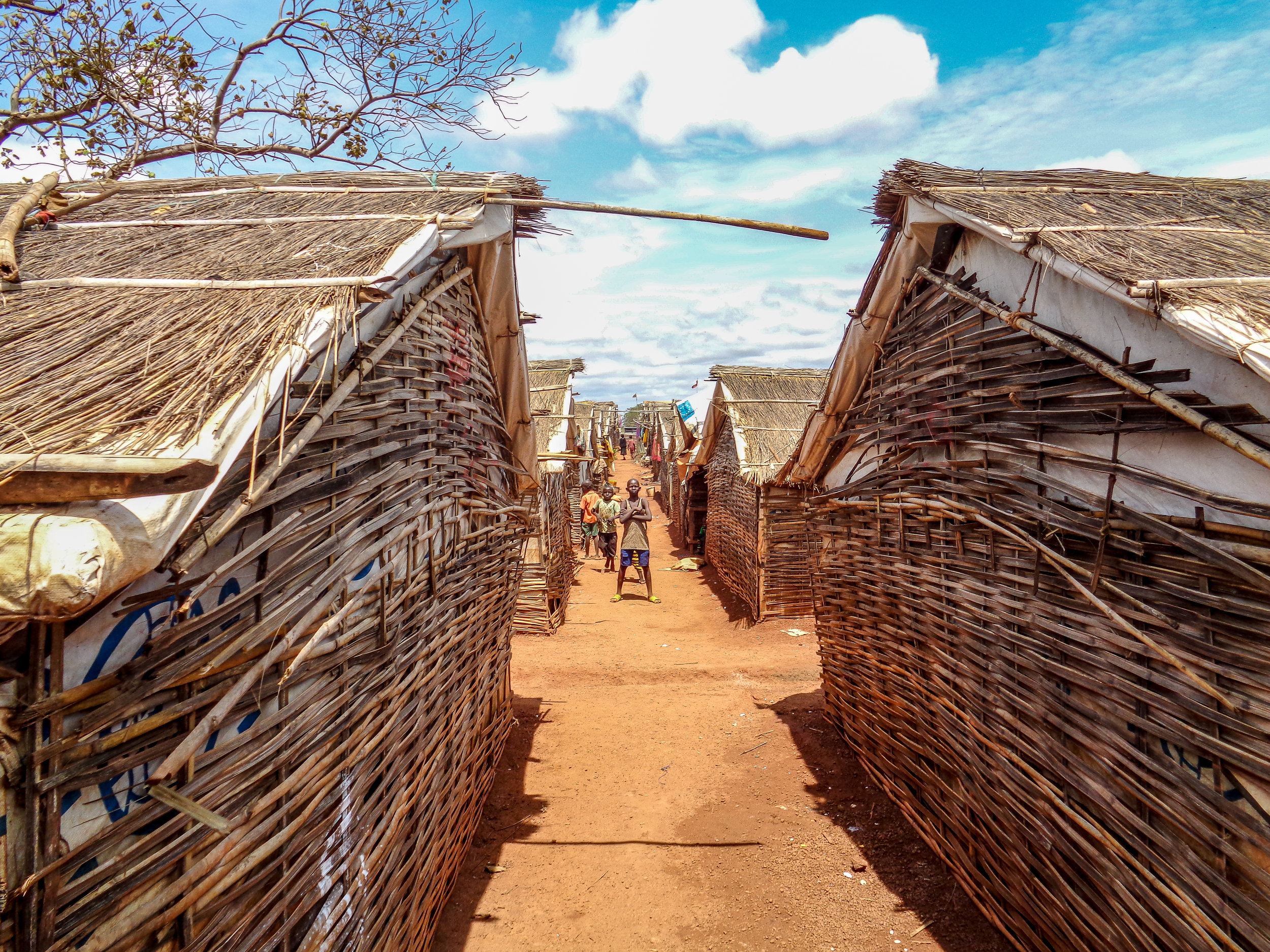
View of shelters in Due south Sudan where internally displaced people live in a Un-hosted Protection of Civilian site (PoCs). Photo Credit: Refugees International.
South Sudan: In Africa, at that place are several critical humanitarian and deportation crises, merely the continent and its humanitarian challenges have received little attention from the Trump administration. Among those challenges is South Sudan. Given significant prior U.South. engagement in South Sudan and the U.S. office in helping to bring independence to the country, the absence of continued U.S. engagement has been sorely felt. Despite a fragile peace agreement, food insecurity levels and displacement remain among the highest in the globe. The position of U.S. Special Envoy to Sudan and South Sudan remained vacant until earlier this year, when the post was filled—simply but for Sudan. The take a chance of famine and further atrocities remains loftier, yet the United states of america is largely absent.
Refugee Women and Girls
Grade: D (Unsatisfactory, but minimallyacceptable)
Women and girls are particularly vulnerable to abuses in humanitarian crises and already existing inequalities are oft worsened during displacement. Every bit during the first half of Trump'south presidency,his administration continues to impose policies that either roll dorsum or threaten important global gains for the protection of women and girls.
Every bit Refugees International highlighted in last year's report card, in January 2017, the assistants reinstated and expanded what had been known every bit the Mexico Urban center Policy, too known as the Global Gag Rule. The misnamed "Protecting Life in Global Wellness Assistance" policy blocks U.South. financial assistance to foreign NGOs that advocate for or provide information, referrals, or services related to legal ballgame, even when such activities are financed by non-U.S. government funds. According to enquiry conducted past Stanford University, the policy really leads to an increase in unintended pregnancies and abortions. The International Women's Health Coalition recently conducted a written report on the furnishings of this policy and found that later two years, the policy has affected $9 billion in funding and has made a broad range of crucial wellness services inaccessible to some of the most marginalized communities around the globe, including survivors of gender-based violence.
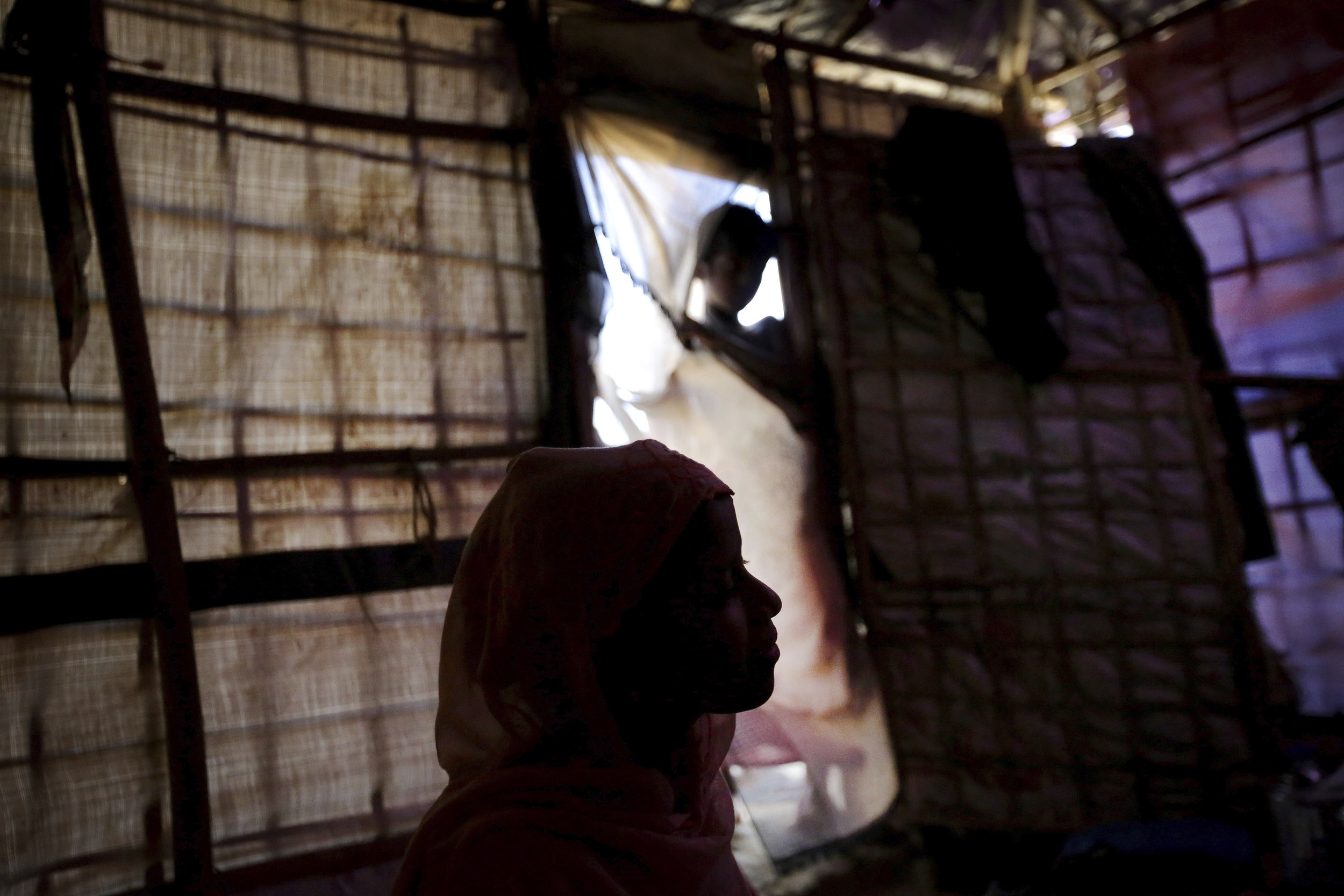
R, a thirteen year-old Rohingya girl, is seen in silhouette in her tent in Kutupalong refugee campsite in Bangladesh. Photo Credit: Wong Maye-Eastward/AP Photograph.
In early 2019, the assistants took the policy even further. The U.S. government at present volition not fund foreign NGOs that apply whatever monies—even if those monies exercise non come up from the U.Southward. government—to back up other organizations that provide information on abortion.
Equally we indicated last twelvemonth, there is an exception to these prohibitions in the case of humanitarian and disaster-related foreign assistance accounts, which is 1 of the reasons Refugees International has awarded the Trump administration a D rather than a completely failing grade. But much non-emergency funding, which has been affected past the prohibition, builds resilience for women and girls who may find themselves in humanitarian emergencies.
In a separate activeness, for the third yr in a row, the United States withheld funding completely from the Un Fund for Population Activities (UNFPA), the lead UN bureau ensuring that women and girls who have fled disharmonize obtain admission to disquisitional sexual and reproductive wellness services, too as services relating to preventing and responding to gender-based violence. The terminated U.S. funding to UNFPA had as well included support for humanitarian and disaster response.
In June 2019, Senior Advisor to the President Ivanka Trump, presented the The states Strategy on Women, Peace, and Security to Congress, every bit mandated past the Women, Peace, and Security Act, which became law in Oct 2017.
The strategy recognizes that women and girls are disproportionally and uniquely afflicted by conflict, take untapped potential, and should be afforded pregnant participation in peace processes, which is the other reason the assistants received a D rather than an F. Co-ordinate to the strategy, "In many conflict-affected and frail settings around the world, malign actors deliberately target and attack women and girls, oft with impunity, for various forms of violence including, but non express to, concrete and sexual violence, torture, mutilation, trafficking and slavery." It goes on to notation that, "Most survivors never receive justice and instead, face considerable challenges in gaining admission to the medical, psychological, legal and economic back up that is needed to help them rebuild their lives." However, there is no mention of sexual and reproductive health in the strategy, leaving out a vital role of women's recovery from disharmonize.
Further eroding U.Due south. leadership on women's protection worldwide, in April 2019 the administration stood lone in vetoing a version of what became UN Security Council Resolution 2467, which condemns sexual violence confronting women and girls during wartime and recommits UN member states to provide the necessary support to survivors of such violence. The U.s.a. was the only land in the world to vote confronting the resolution. Instead of recognizing that women and girls who are victims of rape should exist afforded sexual and reproductive wellness services necessary to heal and regain their lives, the United States strong-armed the removal of the phrase "sexual and reproductive wellness."The United States signed on one time the phrase was removed, simply the initial veto and subsequent change in language was deeply disappointing.
These actions are even more alarming considering the escalation of widespread crimes of violence against women and girls. The number of reported incidents of sexual violence globally, both in and out of wartime, doubled in the first three months of 2019 compared to the aforementioned menstruation in 2018. So far in 2019, the countries with the highest recorded incidents of sexual violence against women and girls include the Democratic Commonwealth of the Congo, followed past India, South Sudan, Republic of burundi, and Mozambique and Zimbabwe.
The decisions made by this administration will directly impact the abilities of the U.Southward. authorities, and the capacity of UNFPA and other aid agencies, to provide women and girls with disquisitional sexual and reproductive assist in the context of conflict, disasters and in rehabilitation programs.
Strengthening the Multilateral Arrangement of Refugee, Migration, and Humanitarian Response
Grade: F (Unsatisfactory—declining course)
In December 2018, Un Member States voted overwhelmingly to approve ii landmark international arrangements: the Global Meaty on Refugees (GCR) and the Global Compact on Migration (GCM). The GCR aims to strengthen the international response to large movements of refugees and protracted refugee situations. The GCM is an agreement amongst governments to establish common principles and approaches to deal with the growing challenges of international migration.
The United States supported neither. While the Trump administration participated in two years of negotiations on the GCR and offered back up for much of what was included in the final agreement, the Us ultimately voted against the UN resolution that approved it. Explaining its rationale, the administration noted its objection was due to language in the resolution that runs counter to U.Southward. sovereign interests, including that it "calls upon" fellow member states to implement the GCR. Out of all United nations Member States, only Hungary joined the United States in voting no. Governments around the world, UN organizations, ceremonious guild groups, international financial institutions, the private sector, and others are all working toward the constructive implementation of the GCR while the United States sits on the sidelines.
The United States likewise voted confronting the adoption of the GCM. This was non a surprise since the administration withdrew from negotiations on the Compact back in 2017. U.S. date had made great sense equally the Us is host to the largest number of migrants in the world. In withdrawing from the diplomatic discussions around GCM and opposing its adoption, the U.s. has abdicated responsibility for an of import global agreement that will play a central role in developing programs of cooperation between governments, common approaches on provision of assistance, and measures to gainsay human trafficking, among other initiatives.

Venezuelans cross the Simon Bolivar international bridge from Venezuela to Colombia. Photo Credit: LUIS ACOSTA/AFP/Getty Images.
While both documents are clearly designed to encourage consensus on disquisitional issues facing humanity, neither document is legally binding, making the U.Due south. decision to isolate itself based on claimed concerns about sovereignty especially disappointing.
Refugees International remains concerned past the Trump assistants'south politicization of humanitarian aid. U.South. administrations accept historically embraced the principles of neutrality, which ways that that humanitarian aid providers should non take sides in political conflicts, and independence, which ways that humanitarian action must exist separate from political objectives of one side or another in a conflict. For this reason, Refugees International and many other international organizations and NGOs were greatly concerned by the United States' willingness, early on in 2019, to tie Venezuela's political opposition with a U.S.-supported attempt to provide cross-border aid from Republic of colombia into Venezuela.
To be clear, sustaining the principles of neutrality and independence in the provision of humanitarian aid would non plant credence of the political condition quo in Venezuela; nor would it require that the U.s.a. avoid deportment to promote political change in Venezuela. But humanitarian action must not be leveraged for political ends, in large measure because the politicization of aid in this manner makes it likely that parties to a conflict will limit access to those in need; politicization too threatens the safety of humanitarian aid providers.
Equally nosotros indicated in last year's study, a tertiary principle, known as "impartiality," has also guided U.Due south. policymakers, however imperfectly, over many years. In the area of humanitarian response, impartiality means that life-saving and life-sustaining humanitarian assist to vulnerable populations should be delivered "solely on the basis of need, without discrimination between or inside affected populations." And as we also reported terminal year, the Trump administration disregarded this principle of impartiality when it ended U.S. contributions to the UN Relief and Works agency for Palestine Refugees (UNRWA). To be sure, administration officials madepostal service-hoc claims about UNRWA effectiveness and direction (and those would be fair concerns to raise in the context of a principled contend on UNRWA), but information technology was unquestionably clear, based on a number of statements, including by the president himself, that the aid was cut considering the administration opposed positions espoused by the Palestinian political leadership. The withdrawal of support has had tangible humanitarian consequences for life-sustaining help to children, women, and men in Hashemite kingdom of jordan, Lebanon, Syria, and the West Bank and Gaza Strip.
Conclusion
Over the by two years, twenty-four hour period in and solar day out, the country and the world has witnessed a range of practices and policies from the White House that exhibit full-spectrum hostility towards some of the earth'due south near vulnerable people. Refugees International believes it is critical to business relationship for the totality of the administration'southward decisions and actions in a comprehensive and singular document. Hence, this study card. It is quite one thing to read nearly a policy in isolation, or fifty-fifty several in sequence; it is quite another to read about all of them in one place. This certificate shows a continuum of cruelty that should shock the conscience of all Americans and phone call them to question what is existence done in their names. We expect a common reaction amid readers who care near these bug to be:We didn't know it was this bad.
"The world is watching the United States and this assistants. And and then are we."
And brand no fault: Equally bad equally terminal twelvemonth'due south performance by the Trump administration was, this year'southward performance is even worse. Its effects are rippling around the earth because the influence of U.S. policies doesn't finish at the water'southward border. The president'southward anti-refugee and anti-asylum rhetoric has been adopted and amplified by other politicians around the globe. If left unmonitored and unchecked, these sentiments will lead to a globe that is not only less empathetic, but less equipped to bargain effectively with humanitarian challenges that are so compelling and volition touch on societies in both the global southward and north.
That is why we at Refugees International believe then strongly in our responsibleness to bear witness to the practices and the policies of the U.S. assistants, and to report and advocate around lifesaving aid and protection for refugees and other displaced persons. That is why nosotros began last year to issue this report card and will do then annually in the years to come up. We believe strongly that the conversation around humanitarianism and refugees tin can be moved in a more responsible and compassionate direction.
The globe is watching the United States and this administration. And and then are we.
Source: https://www.refugeesinternational.org/reports/2019-administration-report-card
0 Response to "Did Trump Cut Funding for People Who Review Asylum Cases"
Post a Comment