The Picture of Dorian Gray Review Tilted Wig
The Picture of Dorian Greyness had a notorious reputation fifty-fifty before it was used against its writer, Oscar Wilde, at his trial for gross indecency. Where information technology may lack originality in its premise, information technology more than makes up for information technology in the evocation of the contrasts and contradictions of high and low nineteenth century London guild.
Basil Hallward and Lord Henry Wotton manage to maintain a friendship despite existence very different men. Hallward, a painter, is a man of potent moral convictions merely, he fears, weak graphic symbol. Situations that may lead him off-target cause him swell anxiety and will ordinarily result in him seeking an escape. Wotton, an aristocrat and a slap-up, in contrast, revels in his repute for existence a hedonist and a libertine. In fact, Wotton is quite mischievous. Despite the reputation he cultivates, he does not human action on his supposed principles. Rather, he enjoys the effect his scandalous remarks accept on those around him and prefers to influence others to indulge themselves while he observes the results. Naturally, Hallward finds Wotton antagonising.
'You are an extraordinary fellow. Y'all never say a moral affair, and you never practise a wrong affair. Your pessimism is only a pose.'
Wotton senses a new opportunity for mischief when he visits Hallward to see his latest work – a full-length portrait of a young man of infrequent personal beauty. Initially, Hallward refuses to reveal the field of study's identity, before telling Wotton about his first run across with Dorian Grey. Hallward certainly does non want Wotton to run into this man who has affected him so profoundly. It is at that moment that Gray's inflow is announced.
Lord Henry looked at him. Yes, he was certainly wonderfully handsome, with his finely curved scarlet lips, his frank blueish eyes, his crisp golden hair. There was something in his face that made i trust him at once. All the candour of youth was in that location, also as all youth's passionate purity. One felt that he had kept himself unspotted from the globe. No wonder Basil Hallward worshipped him.
Later on being introduced to Gray, Wotton wastes no time to set in motion his usual tricks. Wotton immediately launches into delivering a sermon to the young man all almost influences and impulses; sin and temptation; fear, courage and submission.
'I believe that if one man were to live out his life fully and completely, were to requite form to every feeling, expression to every thought, reality to every dream – I believe that the world would gain such a fresh impulse of joy that we would forget all the maladies of [medievalism], and return to the Hellenic ideal – to something finer, richer than the Hellenic ideal, it may be. […] The body sins once, and has done with its sin, for action is a fashion of purification. Zip remains then only the recollection of a pleasure, or the luxury of a regret. The only mode to get rid of a temptation is to yield to it. Resist it, and your soul grows sick with longing for the things it has forbidden to itself, with desire for what its monstrous laws have made monstrous and unlawful.'
[…] 'Cease!', faltered Gray, 'stop! You bewilder me. I don't know what to say. At that place is some answer to y'all, but I cannot find information technology.'
Greyness, young, somewhat innocent and non very introspective, is impressed by Wotton's ideas, especially when Wotton warns Gray that his beauty will inevitably fade. When Hallward shows Gray his portrait, Gray is initially joyful at the representation of his beauty, but, remembering what Wotton said, grows resentful. He is even jealous that, while his looks will fade, the painting volition remain beautiful and mock him. He wishes their places could be reversed – that his likeness in the painting would age while he remained youthful.
'How lamentable it is!' murmured Dorian Gray, with his optics still fixed upon his ain portrait. 'How sorry it is! I shall abound one-time, and horrible, and dreadful. Information technology volition never exist older than this item day of June…. If it were merely the other way! If it were I who was to exist always young, and the painting that was to grow former! For that – for that – I would give everything! Yes, there is nix in the whole earth I would not requite! I would give my soul for that!'
Under Wotton's influence, Gray begins taking tentative steps exterior his comfort zone and the walls of respectable society. When he cruelly breaks a young woman'due south heart, he discovers that his wish has get true – his portrait bears the mark of his cruelty and he does not. Though he is briefly remorseful, Wotton counsels Gray out of his conscience. Gray now feels an unprecedented liberty to follow his desires, to succumb to temptations of sin.
Eternal youth, infinite passion, pleasures subtle and secret, wild joys and wilder sins – he was to accept all these things. The portrait was to bear the brunt of his shame: that was all.
The Picture of Dorian Gray gets off to a corking start. The descriptions of the characters and the locations, which come together in their social gatherings, immerses the reader with its impression of a privileged, elite, social class inhabiting London gild of the tardily nineteenth century. Add to that the incessantly quotable witticisms of Wotton and the morality tale of Grayness'southward pursuit of vice without issue, and the reader can exist swiftly seduced into this world.
If you were already aware of the outline of the plot, you might assume that it is a fairly straightforward tale but in fact the novel has more complexity and thoughtfulness to it. In particular, I enjoyed some of the contrasts between the characters, major and minor, and how their aspects conflict and conspire. I idea the development of Gray's character was well-worked and thought out. When we first meet Grayness, he is very innocent and vulnerable. One time Grey begins his journey from innocence and vulnerability to self-corruption, he grows in confidence and self-assurance and knows his ain mind well plenty to be outspoken in disagreement. And, original or not, I thought the use of the transforming painting made an interesting literary device.
His unreal and selfish love would yield to some higher influence, would be transformed to some nobler passion, and the portrait that Basil Hallward had painted of him would be a guide to him through life, would be to him what holiness is to some, and censor to others, and the fear of God to us all. At that place were opiates for remorse, drugs that could kill the moral sense to slumber. But here was a visible symbol of the degradation of sin. Hither was an e'er-present sign of the ruin men brought upon their souls.
Though direct, I enjoyed a lot of the narration and some scenes were wonderfully dramatic and will be quite memorable.
Several interesting themes are explored in the novel. There is the superficiality in culture, particularly amongst the social elites, and the premium it places on appearances, youthfulness and beauty. Wotton's hedonistic philosophy, which he contemplates and observes rather than indulges in, is taken to its extremes past Gray who experiences its moral implications. Taken together, these combine to show the reader the error of mistaking appearance for reality, specially when making assumptions of good moral character on members of high society and the good looking.
Sin is a thing that writes itself across a man's confront. It cannot be concealed. People talk sometimes of secret vices. There are no such things. If a wretched man has a vice, it shows itself in the lines of his mouth, the droop of his eyelids, the moulding of his hands even.
At that place are questions about the part and purpose of art versus the artful ideal. Heredity equally destiny is explored as some characters encompass the legacy of the forebears while others seek to escape it. There is also the disharmonize between the public and private selves and the fantasy of living a double life.
There were a few things I did not enjoy in The Motion-picture show of Dorian Gray. Wotton speaks mostly in epigrams which, at beginning, can be deliciously witty. There are, in fact, far too many clever lines to quote. But I felt that this can soon go dull and Wotton tiresome.
'A woman volition flirt with anybody in the world as long equally other people are looking on.'
'How fond yous are of maxim dangerous things, Harry! […] You lot are talking scandal Harry, and there is never whatever basis for scandal.'
'The basis of every scandal is an immoral certainty,' said Lord Henry, lighting a cigarette.
'You would sacrifice everyone, Harry, for the sake of an epigram.'
Knowing that The Moving picture of Dorian Gray was Oscar Wilde'south only novel and that it was used equally evidence against him at his trial, I had mistakenly causeless that it was written belatedly in his career. In fact, it was published before his major plays, such as Lady Windermere'southward Fan and The Importance of Existence Earnest, which recycled some of the lines from The Picture show of Dorian Grayness. The early on parts of the novel read a bit like a novel written past a playwright. Past that I mean it can exist a bit dialogue-heavy and that dialogue is very straight and unsubtle. The reader can effortlessly imagine the scenes taking place on stage. Elsewhere, the novel could have used less subtlety – there are some key exclusions at important plot points.
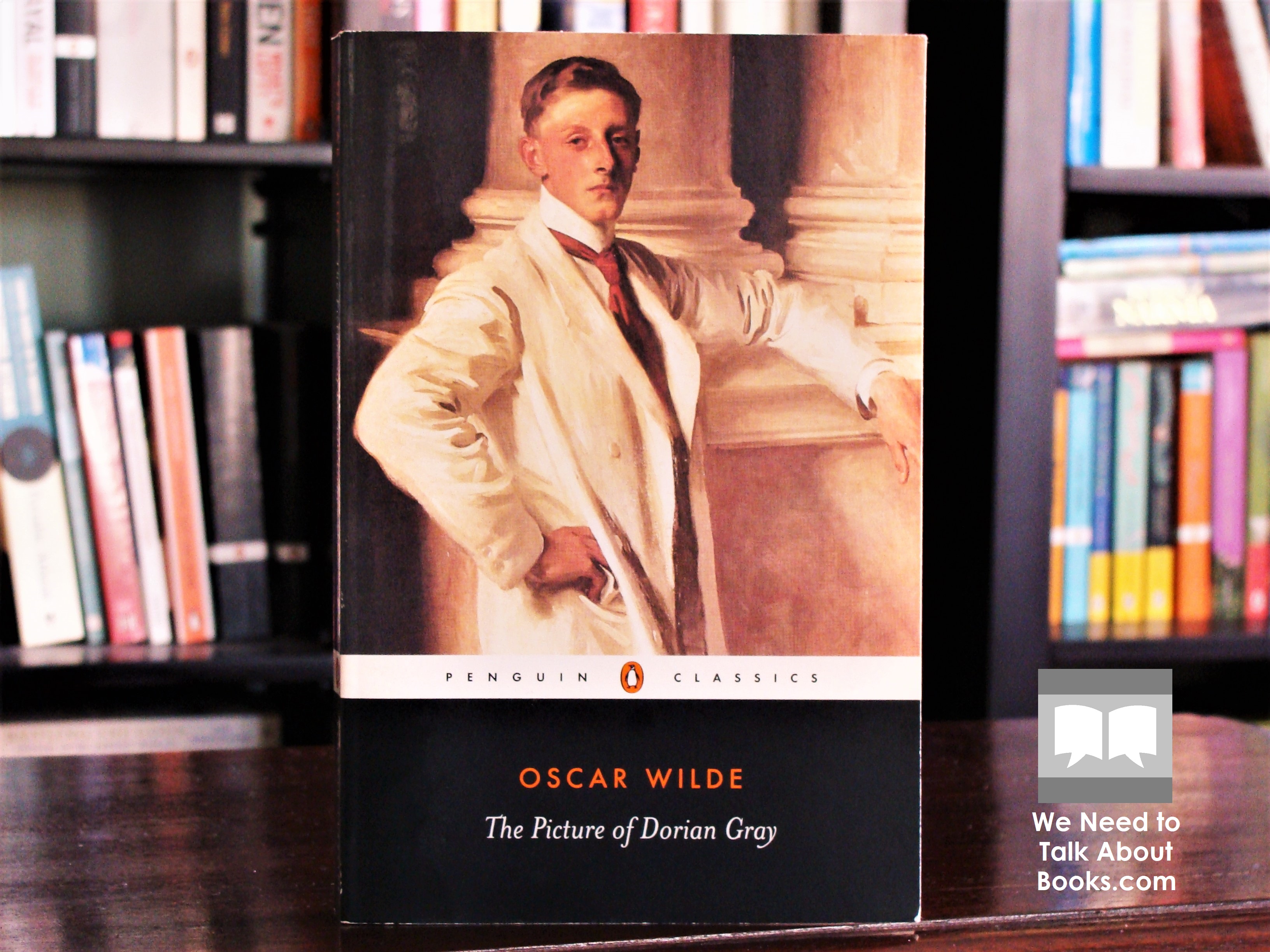
One of the advantages of reading this Penguin Classics edition is that it includes an appendix of contemporary reviews of The Moving picture of Dorian Gray which give an impression of the novel's reception and which I enjoyed reading. Most of the reviews were at least a little negative, some very. Some simply establish the story and the writing to be not very skillful – stupid, vulgar, boring, boring and giddy were some of the adjectives of one. Simply most critique the book for its 'moral'. Some say the story does accept a moral but it is an 'evil' one, some say it does not do enough to testify a moral preference. Some reinforce their argument by maxim that Wilde'due south defence of the story's moral is contrived and inconsistent while others contradict this by saying Wilde dismissed whatsoever moral interpretation of the story which they establish untenable.
These seem a little exaggerated and unfair. I don't recall works of fiction necessarily demand to show moral preference in their telling. Otherwise tragedy has trivial room to work with. Empathy and sentence of the characters and their actions can be left for the reader to interpret. One wonders if Edgar Allan Poe or Robert Louis Stevenson were similarly critiqued. On the other hand, since critiquing the idea that fine art should accept some moral value or purpose, as opposed to the aesthetic ideal of 'art for art's sake', is one of the points of the novel, such a reaction is probably fitting.
Some included in the selection were a flake more positive though not necessarily for flattering reasons. A review from the Christian Leader enjoyed the unfavourable portrayal of the 'gilded paganism' of the era which it likened to the worst excesses of Rome! It as well enjoyed the fact that Grayness is shown to have been led off-target in part past reading a dangerous book.
This edition too independent the Introduction by Peter Ackroyd from an earlier Penguin Classics edition. My principal takeaway from this introduction was Ackroyd's point that London, similar Gray, has a double life in the novel; the decadence of London's exclusive clubs assorted with its opium dens.
English readers were not accustomed to such a forceful characterisation of their civilisation, and Wilde went even further than this; he mocked both the artistic pretensions and the social morality of the English, and some of the about powerful passages in the novel disclose the grinding poverty and hopelessness against which 'Society' turned its face. Wilde, an Irishman, was putting a mirror up to his oppressors – and their shocked reactions would somewhen encircle him when he stood in the dock at the Erstwhile Bailey.
My primary takeaway from reading the new Introduction by Robert Mighall was the message in the novel of a mutual influence between culture and abuse – a point which immediately brought to my heed a modern double life immorality tale – American Psycho. Mighall seems sceptical of how much originality can be attributed to The Motion picture of Dorian Gray with reason. Tales of double lives, of fatal deals for eternal youth and magical paintings have a long history in ancient mythology and medieval legend – Faust and Narcissus being two that immediately come to heed.
Perhaps if I had kept some of these antecedents in mind while reading The Flick of Dorian Gray, I might have enjoyed it less. But perhaps not. I call back Wilde does enough to complicate the story with incidents, characters and themes exterior of, and diverting to, the primary story. If some elements are unoriginal, this is offset by the context of the catamenia setting where the issues of the twenty-four hour period are inserted into the story, giving it a point of divergence to other iterations. It does have a complicated history, though, with controversy and multiple revisions that tin can confuse and irritate attempts at a consequent interpretation. For me, The Picture of Dorian Gray joins a very big pile of books that I did savor but not tremendously.
Source: https://weneedtotalkaboutbooks.com/2020/08/22/the-picture-of-dorian-gray-by-oscar-wilde-a-review/
0 Response to "The Picture of Dorian Gray Review Tilted Wig"
Post a Comment